
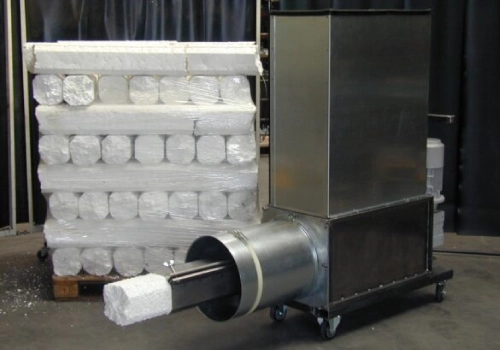
If your business produces a significant amount of polystyrene waste, you might be overlooking an opportunity to save on disposal costs and generate additional revenue. While polystyrene, particularly expanded polystyrene (EPS), is often seen as difficult to recycle, the truth is that businesses can recycle it efficiently, if they have access to the right tools and processes.
Polystyrene is incredibly lightweight and bulky, making it incompatible with standard compactors designed for dense materials like cardboard and textiles. For businesses producing large volumes of EPS, using regular compactors means inefficient waste handling, increased transport costs, and wasted storage space.
However, with a specialised polystyrene compactor, or briquetting machine, businesses can compress this material into dense blocks, drastically reducing its volume and unlocking its potential as a recyclable commodity.
Polystyrene is composed of 98% air and only 2% plastic, meaning it occupies substantial space while weighing very little. Specialised recycling equipment addresses this challenge by compacting the material:
Polystyrene compactors compress EPS into manageable blocks, reducing its volume by up to 40:1, or close to 98%.
Briquetting Machines: These devices produce dense briquettes that are uniform and easy to handle, transport, and sell.
Briquetting machines can convert bulky EPS waste into dense briquettes weighing up to 700kg/m³. A single pallet can hold around a tonne of compacted polystyrene, making transportation far more cost-effective.
Recycling polystyrene not only minimises waste but also transforms it into a valuable resource. Compacting polystyrene enables it to be reused in the manufacturing of new polystyrene products like packaging and insulation, and rigid plastic items, such as toys, electronics casings, and picture frames.
What’s more, businesses can sell compacted polystyrene to companies like Compact & Bale for up to hundreds per tonne, turning a waste stream into a revenue source.
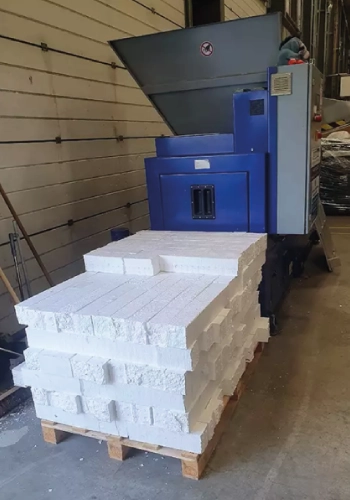
A wide variety of polystyrene types can be recycled, including dry EPS, commonly used in packaging and insulation; wet fish box polystyrene, found in the food industry; specialist Styrofoams, including EPE, XPS, PUR, EPP, and PSP, which are often used in protective packaging and industrial applications.
The benefits of EPS baling machines for recycling polystyrene can be far-reaching for businesses. It can contribute to cost reduction due to fewer waste collections being required; revenue generation through the sale of recycled polystyrene; improved efficiency through better storage and handling processes; the demonstration of environmental responsibility and your business’ commitment to sustainable practices, which can appeal to clients and partners who are environmentally conscious.
Businesses producing consistent volumes of polystyrene waste—such as manufacturers, food retailers, or distributors—stand to gain significantly by recycling it. Investing in specialised recycling equipment allows you to transform bulky, costly waste into a compact, marketable resource. If your business is still paying high disposal costs for polystyrene, it’s time to explore how recycling could enhance your operations and improve your bottom line.