
When recycling in large quantities, companies are looking to mitigate their expenses regarding waste pick-ups, and mill-size vertical balers are a great way to overcome these challenges. Capable of producing dense bales up to 450 kg, they reduce transport costs, maximise storage space, and ensure full compliance with recycling rebate schemes.
We compared the PHS Wastekit 3600 and the Compact & Bale-supplied Strautmann BP53 to see which offers truer performance and long-term value.
Build Quality and Design
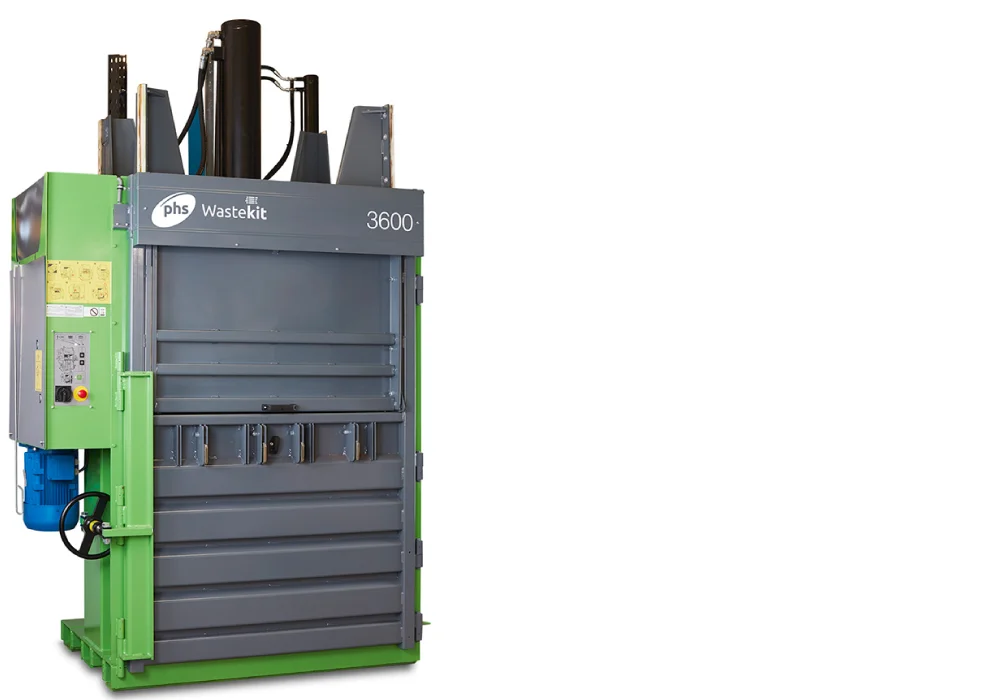
The Wastekit 3600 is a heavy-duty vertical baler with a tall frame and wide loading aperture. It’s designed for large cardboard boxes, shrink wrap, and bulky recyclables, and its robust design makes it suitable for continuous use.
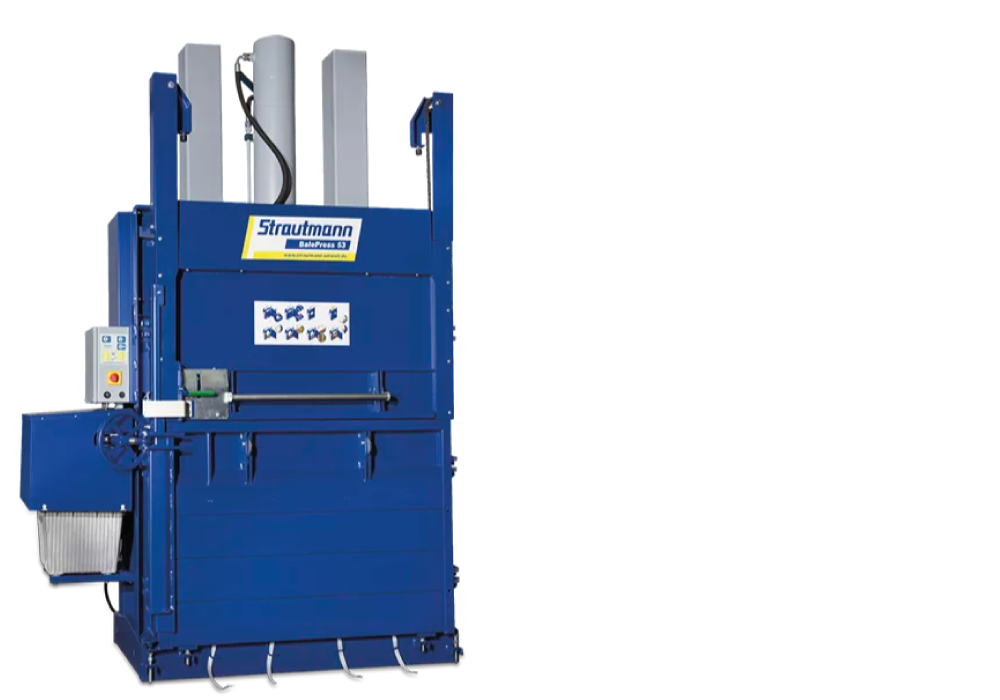
The BP53 is similarly built with reinforced steel and a powerful hydraulic press. It has a slightly smaller footprint than some mill-size models, making it easier to fit into tighter sites while still handling high volumes.
Verdict: Both are solid, industrial-grade machines; the BP53 is more compact for limited spaces.
Performance and Capacity
The 3600 produces bales of up to 450 kg, ensuring full compliance with mill-size rebate requirements. This makes it ideal for sites that want to maximise the value of their recyclables.
The BP53 produces bales of up to 450 kg as well, which are also rebate-compliant and transport-optimised.
Verdict: Both produce similarly heavy bales but the BP53 has the (slightly) higher press force (53 tonnes compared to the 3600’s 50 tonnes); the BP53 delivers consistent, rebate-ready density.
Usability and Features
The Wastekit 3600 is straightforward to operate with a large feed opening and safe bale ejection system. It’s effective but requires space and clearance due to its height.
The BP53 offers a user-friendly interface, safe bale ejection, and Compact & Bale’s training and servicing as standard. It’s built with integration in mind, making it easier to combine with conveyors, bin tippers, or other site equipment.
Verdict: Both are user-friendly, but BP53 has stronger integration and training support.
Energy Efficiency and Running Costs
The Wastekit 3600 uses a 3-phase motor and is efficient for its size. Servicing and maintenance are provided through PHS Wastekit.
The BP53 also runs on a 3-phase supply with similar energy usage. Where it differs is Compact & Bale’s rebate and collection model: by collecting bales and paying customers for recyclables, Compact & Bale offset running costs and create a new revenue stream.
Verdict: Equal on energy, but BP53 reduces lifetime cost with rebate services.
Specification Comparison: Wastekit 3600 vs BP53
| Feature | PHS Wastekit 3600 | Compact & Bale BP53 |
|---|---|---|
| Type | Vertical mill-size baler | Vertical mill-size baler |
| Press Force | 50 tonnes | 53 tonnes |
| Bale Weight | Up to 500 kg | Up to 450 kg |
| Power Requirement | 3-phase | 3-phase |
| Cycle Time | 42 seconds | 32 seconds |
| Loading Aperture | Wide, tall opening for bulky material | Wide, compact design for easier loading |
| Bale Ejection | Automatic | Automatic |
| Suitable Waste | Cardboard, plastic film, packaging | Cardboard, plastic film, packaging |
| Aftercare & Service | PHS Wastekit service | C&B servicing + collection and rebates |
Why Bale Weight Matters
The 3600’s 500 kg bales give it a clear advantage for sites producing very high volumes of waste. However, the BP53’s 450 kg bales remain fully rebate-compliant, and with Compact & Bale’s rebate model, businesses consistently recover more value over the machine’s lifetime.
Wrapping Up
The PHS Wastekit 3600 is a powerful, heavy-duty baler. It’s a strong choice for sites handling very bulky waste and looking for the heaviest bales possible.
The Compact & Bale BP53 matches it in durability and usability while delivering rebate-compliant bales. With Compact & Bale’s collection and rebate service, the BP53 becomes a complete waste management solution.
For businesses that are focused on efficiency, service, and financial return, the BP53 is the best choice.